 Third Biome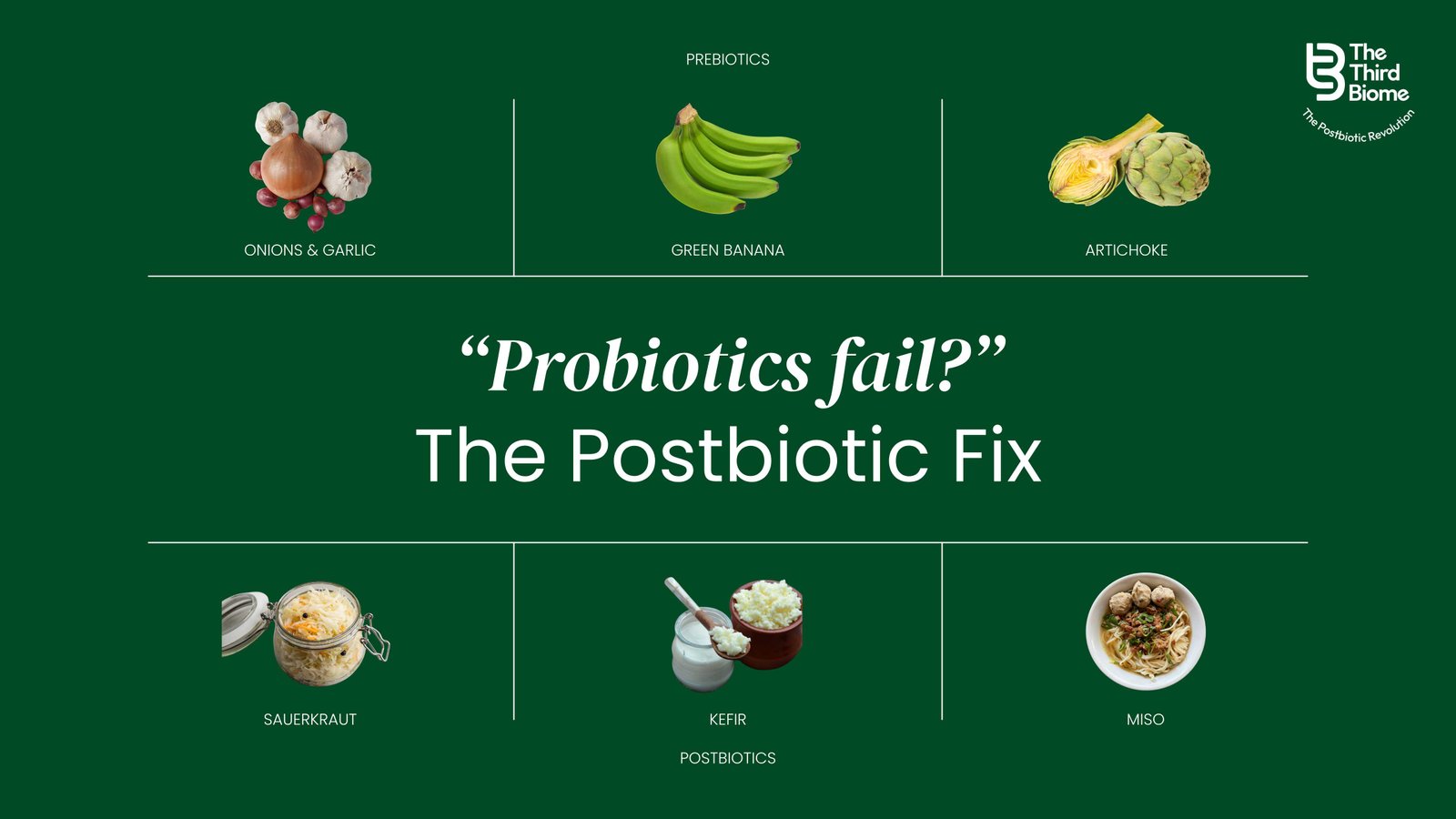
You did everything the right way. You bought the expensive probiotic that has a lot of CFUs. You took it all the time. You waited. And three months later, you still feel full after lunch. Still tired at 3 PM. Still reaching for antacids.
You aren't doing anything wrong. The supplement has structural limits. And the science that explains why has also come up with the answer: postbiotics, and more specifically, Thirdbiome GTB from Third Biome, India's first postbiotic brand.
The Myth of CFU: More Bacteria = Better Results
Colony-forming units, or the number of live bacteria in each dose, are a way to compare probiotics. 10 billion, 50 billion, and 100 billion CFU. The message is that more is better. Science says otherwise. A 2019 study published in Cell found that high doses of probiotics can actually delay the natural repair and resistance (resilience) of some people's microbiomes. Having more germs doesn't mean more benefits if bacteria can't settle in a disturbed gut and survive the journey.
Four Reasons Why Probiotics Fail
Reason 1: Stomach Acid Kills Them
This is the most basic and often ignored problem. The stomach's pH is very acidic, between 1.5 and 3.5. Most probiotic bacterial strains, even those that claim to be "acid-resistant," lose at least half of their viable cell count while they are moving through the digestive system. You could be sending 15 billion CFU to the colon and eating 50 billion. The rest are dead.
Reason 2: They Cannot Colonise a Disrupted Gut
Your gut already has its own community of bacteria, and it naturally resists new ones trying to enter—this phenomenon is called colonization resistance. In a healthy gut, this resistance is actually a good thing because it helps protect you from harmful infections. But the problem is, even when your gut is out of balance—due to things like antibiotics, stress, or a poor diet—it still behaves the same way. It continues to resist new bacteria, even the beneficial ones. Because of this, most probiotic bacteria struggle to survive and settle in the gut, and within just a few days, they are usually eliminated without making a real impact.
Reason 3: They Address Composition, Not the Lining
Most probiotics are meant to change the composition of the gut microbiome by adding more Lactobacillus and Bifidobacterium. But the composition of microbes isn't the most important thing for millions of Indians. It is the natural strength of the gut lining. No matter what kind of bacteria are present, a damaged gut lining with leaky tight connections and not enough fuel for colonocytes will keep causing complaints. Probiotics can't usually heal this lining directly.
Reason 4: Indian Conditions Accelerate Failure
In India, there are more problems with probiotics because of the heat (most strains die above 25°C, and summer temperatures often go above 35°C), acidic, spice-rich diets (which reduce the pH of the stomach), high antibiotic exposure (which makes the gut environment that probiotics need less hospitable), and gaps in the supply chain (refrigerated products are often not stored properly before they reach consumers).
The Postbiotic Fix: Bypassing the Failure Points
By design, postbiotics—more especially, butyrate administered by Thirdbiome GTB—address each of these disadvantages.
Where probiotics fail because they are alive, postbiotics succeed because they are not. There is no survival requirement. No colonization requirement. No heat sensitivity. No supply chain vulnerability. Just direct action on the gut cells that need it
• No gastric acid issue: 100% of the dose reaches the intended location, and Thirdbiome GTB's microencapsulation shields the substance from the stomach, releasing butyrate only at intestinal pH.
• No need for colonization: Butyrate directly affects immune cells, tight junction proteins, and colonocytes. It feeds what already exists; therefore, it doesn't need to create a population.
• Repairs the intestinal lining directly: colonocytes use butyrate as their main energy source. It rebuilds the gut barrier, tightens tight junctions, and decreases intestinal permeability—all of which probiotics are unable to do.
• Thirdbiome GTB doesn't need to be refrigerated, making it heat stable and safe for the supply chain. Throughout the supply chain, it remains effective at normal Indian temperatures.
T3B Club Data: What Happens When You Switch
Members who had previously taken probiotics without experiencing complete alleviation showed a consistent tendency throughout three cohorts of the T3B Club, which included more than 300 members from South India. Within the first two weeks of the 30-day postbiotic therapy with Thirdbiome GTB:
• Most members experienced a decrease in the frequency of bloating
• Members with chronic GERD experienced fewer instances of acidity.
• Throughout the afternoon, energy consistency significantly improved.
• Both constipation and diarrhea-dominant patterns showed improvements in bowel regularity.
This improvement is not because postbiotics are stronger in an abstract sense. The reason for this is because instead of introducing bacteria into an environment that couldn't support them, they addressed the real underlying issue, which was butyrate deficit and compromised gut lining.
Do You Need to Stop Taking Probiotics?
Not often. Probiotics have proven to be clinically beneficial for a number of conditions and situations. In particular, they have been shown to prevent antibiotic-associated diarrhea when taken during an active course of antibiotics, as well as for a number of well-defined conditions where certain strains have strong evidence.
Third Biome's clinical team recommends starting with postbiotics if you have a disordered gut microbiota (e.g., chronic bloating, post-antibiotic symptoms, IBS, PCOD, or years of probiotic use). Start by repairing the gut lining with Thirdbiome GTB. Then add probiotics as necessary to restore diversity. The order matters.
Frequently Asked Questions
Q: Why is my probiotic not working?
A: The most likely reasons are that probiotic bacteria did not survive stomach acid in sufficient numbers, could not colonize your disrupted microbiome, or addressed bacterial composition without repairing the gut lining. Postbiotics like Thirdbiome GTB address the gut lining directly, without the survival and colonisation requirements that probiotics face.
Q: How is Thirdbiome GTB different from a probiotic?
A: Thirdbiome GTB is a postbiotic—not a live bacterium but a bioactive compound that delivers butyrate directly to the gut lining. It does not need to survive stomach acid, does not need to colonise the gut, is heat-stable without refrigeration, and acts directly on the gut cells that need repair.
Q: Can postbiotics replace probiotics entirely?
A: For gut lining repair, metabolic health, immunity, and the downstream effects of dysbiosis, postbiotics are often more effective for urban Indians. For building long-term microbiome diversity, probiotics and fermented foods remain valuable. The most effective approach uses postbiotics as the foundation, then builds on probiotics.
Q: How soon do postbiotics work compared to probiotics?
A: Because postbiotics act directly on gut cells rather than needing to colonize, many people notice digestive improvements within 7 to 14 days of starting Thirdbiome GTB. Probiotics, in the best-case scenario, may take several weeks for colonization effects to manifest—if colonization occurs at all.
Ready to experience the postbiotic difference? Third Biome's Biome Balance, powered by Thirdbiome GTB, is India's first patented postbiotic capsule—developed in Chennai, backed by science, and tailored for the Indian gut. Join the T3B Club waitlist at thirdbiome.com and take our free Gut Health Quiz to find your gut health score in just 3 minutes.